Friday, June 27, 2025

Putting it Together and Teaching OUT

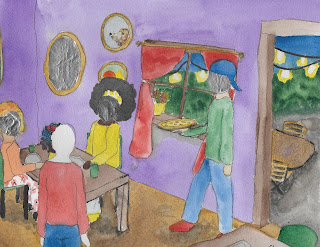
Analyzing what I have taken from this course and wrestling with this information through blog posts and discussions, I felt that coming back to empathy was key in making these topics tangible and actionable for myself and my students. I chose to create a lesson in which students investigate empathy through art and will make this part of my curriculum and ongoing conversations with students in my classroom. You can read more about it in this anticipatory paper that I wrote and investigate the Canva slides and worksheet linked in this post!

All the best to everyone and congrats to all of us in completing the course!

Abi

Anticipatory Paper Link Here

Canva Slides Link Here

Canva Worshkeet Link Here 

Friday, June 20, 2025

Let them Speak


I vividly remember living in Africa and the multitude of times I felt stupid not because I was, but because I couldn't communicate. I worked hard to learn French and local languages, and this helped immensely as I eventually was able to communicate just about anything I wanted, but even then, I was only able to communicate at the level of a young child. I remember leaving meetings with government officials and feeling that I had successfully translated for our non-profit's team only to have my German best friend giggling about how well I had been able to have a discussion while sounding like a four-year-old. I felt accomplished: I came across as barely competent. Which was fine. But I wanted more for my communicative capabilities and was struggling to get out of my limited language bubble.

While this bubble was frustrating, it was also humorous. I'll never forget that I told two bus fare collectors who were fighting for who's bus my friend and I would get on "softly" instead of "knock it off." I was working on it, but I still giggle thinking about a 19 year old, 5'3" white girl going up to two 6' men pushing each other and sternly telling them to do it "softly." The same best friend won't let me live that one down.

While my best friend was "tough" on me and my language development, she was also supportive as I grew. My local friends were guides who helped me learn what to say and what to avoid saying (the French word for "butt" sounds pretty close to the English word for "face," a difference my friend Hawa preventatively pantomimed for me multiple times to make sure I would never make this mistake). And in the middle of it all, even when I felt incompetent, I was surrounded by cheerleaders who would tell me how clever I was for combining English and French to be understood, even if it wasn't "correct" by my standards. 

This experience gives me additional empathy for multilingual students in American schools who are facing the ups and downs of language learning. It is difficult to learn a language to begin with, never mind trying to keep up in school, navigate a new environment, and form new relationships. These students need additional supports as they find their way, encouragement as they make progress, and challenges that keep them invested in learning not just language, but academic content.

In Aria, an essay by Richard Rodriguez, he describes his experience as a multilingual learner in the United States. While he was born in the States, his family's home language was Spanish. He struggled to learn English and felt that this cost him accessibility to a public identity, yet when his family switched to speaking English at the request of his teachers, he felt the loss of his home identity as Spanish left. He was caught in a false dichotomy: English or Spanish. And English won. The nuns who taught him had good intentions, but lacked knowledge that a home language is a powerful, beautiful cornerstone of identity.

Research shows that this dichotomy is harmful. His teachers did not know better, but we do. Multilingual learners do not need to, and should not be forced to, lose their home language to thrive while learning a dominant language. They are best served when both languages, and the cultures associated, are present in the classroom. This is clearly demonstrated in Collier's essay Teaching Multilingual Children. Collier outlines clear approaches and strategies to support multilingual learners by encouraging them to leverage their home language as they learn additional languages. By using their home language, they are able to continue in content, expression, and cognition, maintaining the skills they need to be successful in all areas of life. As they are exposed to more English and gain proficiency, these skills transfer to their academic learning in English. They do not need to face the "either/or" Rodriguez faced - they can truly have the best of both worlds, and teachers and students can mutually benefit from the presence of multiple languages in the classroom.

Making space for students to use their home language and a hybrid of English is a process termed Translanguaging. This approach is powerful. It maintains student voices, that they have value in all languages, and makes room for students to expand their voices into English without shutting down their original languages. It allows students to keep up with grade level expectations while adjusting to a new language, new norms, and new relationships and environments. Students who are free to utilize translanguaging learn more and develop greater freedom in education and society. Everyone benefits.

What is interesting to see is that this is the norm in so many other areas of the world, but so slow to gain traction in America. Where I lived in Djibouti, there was a melting pot of languages. French was the dominant language due to colonization, Arabic was present due to proximity to Arab nations as well as the prevalence of Islam, Somali was spoken by the dominant people group in their homes and on the streets, Afar was spoken in Afar neighborhoods, Amharic was the language of the lower class guards and day laborers from Ethiopia, and so many other languages seemed to just find their way in. You could blend five languages into one sentence and no one would bat an eye. You could pantomime an entire conversation and be termed clever, rather than ridiculous. (If you want a fun experiment, find a way to pantomime "yeast" for bread - that took us a few rounds to figure out at our local corner store.)

There definitely were cases where I still felt stupid for not being able to communicate eloquently, but overall, translanguaging was a norm, and multilingualism was celebrated as the mark of the clever.  Communication mattered more than perfection, and this provided so many safe spaces for me to give speaking in French a chance. We need to learn from this. We need to make space for our students to learn and struggle and say things that sound funny, and we need to make that space sacred and celebrated. We need to value communication, not English. We need to give English as a key to empower better public communication while celebrating home languages and the cleverness it takes to learn in a language that is not from the heart. Instead of being forced between two identities like Rodriguez, lets give our students the gift of wholeness, of knowing who they are and how to authentically connect across languages and cultures. Let's let them speak: they know which language will work best for what they want to say.

My best friend Hemeda, who taught me so much about language and culture!


We focused on sharing a love of reading as a foundation for literacy - the smiles show we made an impact.

Looking Further:

For stories of multilingual learners in America, the following two books can't be beat. Funny in Farsi by Faroozah Dumas and Everything Sad is Untrue by Daniel Nayeria are powerful memoirs that give incredible insight. Both will have you laughing at crying at the wonderful, beautiful, messy process that is making a life and learning a language while you are still young.

Here's a link to a video my friend made about the work my team did in Africa. Not every day was going out to villages like this one, but it definitely was part of what we did! Click Here 


Summary/Artist Statement for Teach Out Project

One of the best ways we can make the world a better place is to stay committed to seeing the humanity of every person we encounter. There is always some kind of connection point, a way that we can see how their life and experience connects with our own. Every person hungers and thirsts, every person wants a "good life" (even if our definitions of that are different), every person wants connection and sympathy. Knowing this, we can always see something of our own humanity in every person we meet. Armstrong and Wildman write about this and call it "seeing the Me" in someone - that point of connection that reminds you both that you are beautifully human, no matter what differences you may have. They wrote about this in an article called Colorblindess is the new Racism to encourage people to look differently to see the experiences of others better instead of ignoring it and only looking at their own experience.

 This connects to the idea of empathy, of entering in to someone else's experience by imagining what it would be like if you were them. How would you handle their situation? What kinds of feelings would run through your body? How would you make it through their challenges and celebrate their wins? Linda Christensen writes about this in an article called Other People's Lives where she describes students writing poetry about other people's experiences as a way to experience empathy.

 As you look at this painting, what do you think it has to say about these ideas? How does it show you "seeing the me" in another person? How does it connect to empathy and the ability to understand someone else's experience? If you made an artwork about this topic, what symbols and/or images would you use to help someone understand you?

Protection and Connection

 I feel like most of my blog posts exist in the tension of "what do we do in the in-between?" This one isn't going to be different.

We are in a world where LGBTQIA+ kids are at risk of harm, homelessness, and harshness when they come out to their communities. We have a responsibility as teachers to protect the children we teach to the best of our ability. These are our realities. But do they have to be? My tension point on this topic is: how do we create a new way to handle protecting our kids that does not involve alienating them from their families and communities? How do we make these communities a safe place where they can receive support instead of discrimination?

Kids need support. They are learning how to be humans from scratch and it isn't easy. They need guidance, they need to be affirmed, they need to be strengthened to be ready for a world that is full of hard things, and they need to be surrounded by beauty to see that this hard world is still a good one. In an ideal world, this support comes from families and is supported by the school environment. But especially with this issue, it seems like schools are participating in severing these ties instead of strengthening them, reversing the roles that best benefit children and perpetuating the struggles these children face instead of resolving them.

This makes sense in some ways, especially since Rhode Island law demands that teachers respect the privacy of students. It requires teachers to let students take the lead on coming out to their communities. But is also expects teachers not to communicate with families that their child is going through what can be a difficult process, and I have to wonder if this really is in the best interests of children. It seems to keep them from the support their families can provide should their families be informed of what their children are exploring.

It is definitely true that not all families are supportive and that this law has the intention of protecting children from families that will respond to their child coming out by beating them or kicking them out. Still, I have to wonder if this is the majority of families and if we might be participating in this response by facilitating secrecy instead of communication and connection. When secrets are leaked, there are explosions. Parents taken by surprise lash out instead of connecting because they feel betrayed. This worsens the problem, it doesn't make it better. What if schools took the lead on facilitating conversations and minimizing the shock factor for families and providing external accountability that would limit a parent's ability to harm their child? What if we believed in our families and held them to a higher standard instead of withholding the opportunity for them to support their children?

There is growing tolerance, even if the growth is slow, but are our methods of handling these situations matching this growth or remaining in the past? How can schools be proactive instead of reactive to culture, facilitating the strengthening of bonds to increase the safety of kids who come out? How can we facilitate spaces where families can be more comfortable with accepting their children and supporting them?

As I mentioned, we are in the "in-between." These kids aren't accepted quite yet, although that is becoming more normal. We can't just "out" them and expect that to be ok - there are real dangers involved. But is it actually ok to also facilitate secrecy between students and what should be their strongest support in life? How can we can get ahead of this issue instead of running behind and trying to pick up broken pieces as they appear? How do we facilitate wholeness to support students and their families and provide a new way for safety that isn't secrecy?


Thursday, June 12, 2025

Good Trouble

 This reading created an absolute tug-of-war inside of me.

Shalaby discusses Troublemakers in a book of the same name. Learning from students who are labeled "defiant," who are the "tough kids," Shalaby seeks to change how teachers see these students from a deficit- to an asset-based lens. Instead of problems, Shalaby asks that we see leaders.

This rings true for me, but with access only to the preface and introduction, I feel lost on how to negotiate this concept within my practice. I agree with the perspective, but I do not understand the practice within the limitations of the current schooling system. How can you have 25+ troublemaker/leaders in a room and not end up with fist fights? How do you channel that energy into productive struggle instead of violence (speaking from experience running true choice based art classes)? How do you teach and encourage "good trouble?" What do you do when students don't rise to the challenges associated with autonomy?

While Shalaby argues that power needs to be handed to students, I think back to Delpit's conversations with learners who felt that teachers needed to use their power more to develop students. These learners talked about teachers who couldn't control their classrooms and who left students disadvantaged due to lack of direct instruction, a style of teaching that relies on the teacher exerting explicit power as the authority of the topic and the primary voice for the lesson. Students felt their learning was disrupted by teachers who were trying to distance themselves from power (even though they never truly did, as we discussed in class). These are contrasting voices with the same goal. Both authors argue for changing the system, with Shalaby seeming to advocate for an immediate change while Delpit seems more pragmatic about equipping students within the system as it exists and changes occur over time. 

The system really is heartbreaking, however. How do we address that school really is not about learning? I grew up homeschooled and I constantly struggle with this as a teacher. School absolutely is about sitting in one spot for 8 hours, listening to someone else talk, and obeying. I did my work in 3-4 hours and graduated high school while carrying a large amount of responsibility for younger siblings, went on to be a founding member of a non-profit in Africa, then returned to get a double major and a minor in undergrad with a 3.95 GPA, and am getting good grades in my graduate studies. My alternative schooling pre-K through high school is a major factor in my successes in formal education and the long list of things I have achieved in my career and personal life. I did not have to sit still for 18 years. I could take breaks. I managed my own time. I could include my own interests. I could spend time with siblings, friends, and an extended community network of all ages, backgrounds, and interests. I regularly spent 3-4 hours a day hanging out with friends online from around the world. I had the freedom Shalaby advocates for and the intrinsic motivation to make the most out of it. But I'm not an amazing outlier - I'm proof there are better systems.

But this can't be provided in a traditional school setting. Behavior has to be managed because every student deserves to be safe from verbal and physical violence, and the social-emotional skills gap that makes it likely that freedom will cause broken bones is real. Kids are sardines in a factory and can't get out and this pressure absolutely has a negative influence, but we also can't let them out because then what? Homeschooling is clearly not an option for most when households already can't survive on two incomes. Adding more SEL is important, but does it really resonate with students? Smaller classrooms sounds great, but it's still mandatory and highly controlled, meaning that there will still be "problem" students causing real problems as they resist systems that are not designed for them to thrive.

Some kind of hybrid is needed that does meet the needs of the population for childcare, that allows parents to work, that provides students with autonomy and safety, and that gives them authentic learning opportunities. Unfortunately, I feel like this blog post is something more like a rant than an answer to this puzzle, but it's what I have for today.

I will say, I have come across some resources that are helping me tease apart different viewpoints to try and get closer to an ideal system where students want to learn, want to lead, can authentically exercise autonomy, and surpass expectations. I'm just still in the process of internalizing it and applying it to my context. Still, I can highly recommend @teachingtoariot and @aishforashlyn on Instagram for helping me branch out in my thinking and explore new ways to approach my practice.

For now, however, I'm going to keep trying Delpit's approach. I'm going to pragmatically work within the current schooling system while giving students all the tools I can to learn, grow, and develop mature autonomy so that they can use freedom for causing "good trouble." I'll definitely have some students calling me a dictator while others think I'm too soft. But for today, it's what I have to offer my students, and I have faith that it is enough to show up while in the process of learning, unlearning, and growing.


Tuesday, June 10, 2025

Teaching Empathy

Going through the Rethinking Schools archive, I came across an article called Other People's Lives by Linda Christensen. Christensen shares about her practice of writing persona poems with students and guiding them through the process of entering into the world of another person and giving them a voice. Teaching not only writing techniques, but empathy, drives Christensen's approach. You can read the article here.

I found this interesting as I have spent my first year of teaching grappling with how to approach empathy. I have found myself frequently discouraged as I ask students about the feelings of others and have been met often with frustration and "how would I know?!" What makes this intimidating to me is not that it seems like students don't care enough to try to figure out the other person's feelings, but the sense in my gut that they actually feel like they cannot enter that person's experience and are genuinely frustrated that I would ask them to do what they see as the impossible. I am learning to readjust my expectations as to the social emotional baseline my students have to work with, while simultaneously pulling my hair out trying to find a way to integrate essential social skills into my classroom so that my students will be able to function in the world when they graduate in four short years. I hoped to find some keys to use in Christensen's article.

Poetry is a key Christensen has to offer, a writing style that is driven by emotion. Christensen says "I want my students to use poetry to cross the boundaries of race, nationality, class, and gender to find their common humanity with people whose history and literature we study." Students experience emotions every day: making space using poetry for them to understand their own emotions and then find the common humanity in people who are "other" is a powerful way for them to build the capacity for empathy. 

History offers many opportunities for students to form these connections. Most have felt grief, or joy, or confusion, emotions people have felt for all of human history. Christensen soaks students in historical context, having them generate a detailed analysis of texts to understand what it was like to live during different events. She tells students to "Lift off from the writer's words and details to fuel your poem." To do this, students have to notice and authentically connect with the person who will be the voice of their poem. 

To inspire quality work, Christensen provides examples done by previous students. Over the course of time, this has meant that family members are teaching the students, leaving a "legacy" of learning in the classroom that is powerful and accessible to students. Students know the work can be done, that they can empathize and then write something worth reading.

Dissection of the poems is left to the students. In Christensen's words, 'There's no better way to kill poetry than to tell someone else what it means." This was powerful to me as I have often found myself explaining artworks to students and watched them tune out completely. I know better - but I need to do better in my art classroom/studio to put students' learning back into their own hands, to give them experiences instead of lectures, to give them doorways instead of windows.

After dissecting poems, immersing themselves in context, and reviewing expectations, students in Christensen's classroom get to work writing persona poems. They have to take on the persona of the person they are writing about, whether that's an Asian-American immigrant burning possessions for fear of being sent to an internment camp or an urban community member being displaced for the sake of development. The poems included in the article are powerful. They are short, but pack a punch, leaving the reader with a chance to practice empathy the way the author needed to in order to write the poem.

I found this powerful and beautiful, but also complicated. Students need these opportunities to experience empathy and express what it means to understand someone else's experience. However, they cannot truly speak for someone else, and I'd love to ask Christensen if she has had any issues with students appropriating or wildly misconstruing someone else's experience. I think about the underlying social skills needed to engage in this activity and I wonder if her students are just more mature than mine, or if survival mode had truly limited the capacity of my students who are coming from hard situations. My students are hungry and exhausted: can they really be expected to reach the top of Maslow's hierarchy of needs before these basic needs are met? If so, how do I do my part to get them there?

Image from this website that explains Maslow's Pyramid: Click Here

Additionally, as I translate Christensen's work into the context of my art room, I think of the deep history of cultural appropriation in art that was normalized until recently. Artists have historically taken the work of other cultures and claimed it as their own without understanding its significance, creating harmful narratives that have aided in the dehumanization and "othering" of other cultures. This is especially true in "primitive" style artworks. While incorporating other cultures into my curriculum, my students and I have  discussions about what it means to appropriate vs. draw inspiration from cultures that are not our own. This is centered in understanding but not stealing someone else's culture and experience. Below is an example of how one of my high achieving students demonstrated this understanding:


Wrestling with how to use this understanding of inspiration, but not appropriating, in art while introducing empathy and connecting with a deep understanding of someone else's experience, my partner reminded me of a documentary showing we attended together about a public art program called Mending Walls. This project by Hamilton Glass saw 16 murals created in one summer in the city of Richmond, Virginia were actually inspired by Robert Frost's poem of the same name. Centered around the discussion of race after the death of George Floyd, these collaborative works required artists from multiple ethnicity to discuss their backgrounds and use their empathetic understandings to create public artworks that authentically shared an experience. Inspiration came from authentic conversation. These powerful works endure today and will be a testimony in the city of Richmond to the power of empathy for years to come. 

This approach stops to truly listen and amplify voices, not just to guess what they may or may not be trying to say. It could be utilized in my art room to help students understand each other and create rich artworks based off of mutual understandings and amplified voices. It would support Christensen's core value of empathy while avoiding many of the struggles that come from trying to tell the story of someone who is not present to speak for themself. While I have many questions about how to make these concepts truly tangible to students who are struggling so much in this area, these conversations where they explore their own experience and learn from their peers may be a powerful way for my classroom to create authentic empathetic experiences in the future.

If you are interested in watching the documentary about Mending Walls, it is truly inspirational and worth the time! You can watch it for free here! And you can check out their website here.

Thursday, June 5, 2025

Teach Out Proposal

 As an art teacher, I want to bring my strengths into this project. My artworks typically center around communication and story telling, and I feel that this aligns well with a project designed to take what I am learning from this class and present it to the rest of the world. I want to ground this artwork in not just presenting social justice in my classroom, but also social-emotional learning. Many students who have acted poorly in my classroom are taken aback when I speak with them about the impact of their actions on others. I'm hoping that this painting will become a focal point in my classroom for the ways empathy empowers better relationships. Many of these conversations aren't tangible to my students, but something they can look at is. A painting can be a space where they can slow down long enough with just enough stimuli to engage deeper reflection.


Wednesday, June 4, 2025

Relevance Creates Engagement

Students creating artworks relevant to them in my classroom, referencing Minecraft and popular "brain rot" themes that are part of the culture they are growing up in. They're using their voices and it's clear they incorporate plenty of humor.


In The Academic and Social Value of Ethnic Studies, Christine E. Sleeter argues that ethnic studies are essential to engaging the diverse population of learners in the American schooling system.

Early on, students of non-European ethnicity notice that they are not reflected in the narratives and materials presented to them. The primary voice in classrooms reflects a Euro-American view of history and values, underplaying the histories and roles of other ethnicities. Students who are not represented by this viewpoint turn to their communities to fill in gaps in these histories, but schools should be supporting these quests for clearer knowledge, not brushing them aside. Students orient their understanding in relationship to their experiences, and we ignore this to our mutual detriment.

It's not possible for one voice to represent everyone.While the Euro-American perspective isn't all wrong, it is just one side of a story, and it is always limited by its perspective. True diversity needs to mean lifting up voices, not just on special occasions, but as a daily practice. Lip service to the benefits diversity is not enough. In order for society to benefit from all the different kinds of voices and strengths in our community, there needs to be authentic support and perspectives need to be held together to create a clearer picture. How to do this is challenging: there are 180 days in the school year, and standards that have to be taught and tests prepped for. But ignoring the introduction of different voices comes at too great a cost to throw in the towel instead of looking for creative solutions.

One of the most tangible benefits of strengthening these voices in schools is authentic scholar engagement.  When student's communities, histories, and voices are included in curriculums, their learning connects to their context and holds meaning. Students don't have to ask "when will I ever use this?!" because it exists in a context where its use is clear. It helps them to understand themselves in a wider context and to understand others. This relevance increases the motivation to learn and gives students a reason to be in school that is much clearer than a hypothetical future job.

Showing students we see the "me"(a concept discussed by Armstrong and Wildman) in them contributes to their motivation to learn, their connection to topics, their relationships with themselves, and their community with each other. This models the kind of society most wish to see, where each person is visible and their contribution is meaningful. It pushes back on color blindness as repudiated by Armstrong and Wildman and instead values each voice for its unique experience and insight.


Tuesday, June 3, 2025

When is the right time to end DEI?

Reading through President Trump's Executive Orders regarding DEI and the responding analysis of The Leadership Conference on Civil and Human Rights, I keep returning to two questions:

1. What is our goal?
2. What are our real limits?

Trump's order gives the impression of saying "TADA! IT'S DONE B*!@(#*@$!" while The Leadership Conference on Civil and Human Rights seems to respond, "TADA! No, no it's not. It's really not." Both are assertive. Both point to history. Both hint at the future. Both cannot be right. It really left me asking: What is our goal in regards to diversity and equality? How do we plan to get there and bring others with us? How will we know when we've achieved it? And how will we respond when faced with roadblocks?

Looking first at the executive orders, it seems clear that Trump refuses to take responsibility for the systemic voids in opportunity that exist for those who do not have cultural privilege. Ignoring the issue perpetuates it. By allowing the divide to continue, it deepens, much like a canyon set between shifting tectonic plates. As time goes on, the rift widens and deepens. It is true that this void is not the "fault" of people of privilege: the system has been handed down for generations. But it IS the responsibility of people of privilege to determine their complicity in this system, and to determine a just course of action in response to the faults of their fathers. Trump's dismissal of this responsibility is dismal, and it speaks to wider cultural views that create barriers to the free and equal society Americans seek to espouse.

While there are pockets of extreme prejudice that remain, the vast majority of Americans disavow the disadvantaging of another person based on their identity. The majority of Americans do believe in the American dream that everyone has opportunity as a born right and that they should not be blocked from achieving their full potential in regards to "life, liberty, and the pursuit of happiness." Most believe this potential is not theoretical, but achievable. Yet in the world around us, there is vast cognitive dissonance. Who we want to be is not yet who we are.

I believe that Trump's support often comes from this cognitive dissonance. There is a reality that one day, we should all hope that DEI does not exist. We should all dream of the day when equality is truly so entrenched that we don't actually have to think about its implementation. One day, we should be able to welcome this kind of order because we know the work is done. But today is not that day.

Growing up and living in primarily white upper class communities, this kind of thinking is what I often see in my neighbors. They support Trump on these issues not because they want to harm others, but because they are ignorant of the work remaining and anxious that these approaches will cause them harm. A common concern I have heard is reverse racism. It's easy to scoff as someone who knows that equality benefits everyone, but scoffing and scolding create enemies, not partners. Partnership means understanding and speaking to underlying presumptions with respect, not scorn, even when someone is clearly in the wrong. Many who support the Executive Orders presume that opportunity was created during the Civil Rights Movement of the 60's and that these initiatives are a step backwards, not forwards. Within their current frame of reference, ending DEI re-levels the playing field that others are trying to tip. While incorrect, this is important to understand, and to assume the best whenever possible, in order to engage effectively with authentic (although often misguided) concerns.

Patience is painful, yet necessary. It takes time and precision to delve into nuance with someone who does not understand and may seem like they want nothing to do with understanding. But this is part of the work that needs to be done if equality is to become the new normal. Clarity paves the way for kindness. Explaining the gap that exists, the measures to close it, and the benefits to all can feel excruciating when these ideas seem obvious. But this is what needs to happen. Over. And. Over. In painful detail. Presenting the clear end result that is not to flip tables, but to pull up of chairs. Many are afraid of losing their place; clarity shows them there is genuinely enough room for everyone.

All this to say: the goal is true equality. Achieved together. With patience and persistence to get everyone on the same page. But what about roadblocks and limits? What does this look like now that executive orders prohibit DEI based action?

The Leadership Conference on Civil and Human Right's summaries of what the Executive Orders do and don't do are succinct and helpful in wrapping one's mind around the roadblocks that have been put up. They clearly outline what is at stake and what isn't, providing key points for reflection and strategy. They also provide clarity on how this is an issue that impacts everyone, not just minorities.

The analysis points out how efforts to reduce inequality clearly benefit everyone by referencing a study done by Citi that estimated that $16 billion dollars of economic output have been lost over the course of 20 years by perpetuated privilege (article and reference linked here). They also speak to the misconception that DEI is about "quotas." Rather, it is about creating pathways for equity that are just that: pathways. It opens doors, but it doesn't push people through who don't have the necessary skills to hold their position. This does not take opportunities from others: it just widens the pool of those who have access by including worthy candidates, not by removing privileged ones. All of this is helpful in discussion and providing a common frame of reference.

That being said, I disagree with a key point of the analysis, that our multi-racial democracy is threatened.

I don't disagree because I think the executive orders are right, or that they are inconsequential. They do have real effects.

I disagree because I believe we are more powerful.

We have a say in the way we shape our societies. We DO have the right to hire intentionally and fairly. We DO have the right to free speech and to gather support for advancing true equality. We DO have the right to elevate marginalized people within our communities. We DO have the right to noncompliance with regulations that do not align with creating a better, fairer world.

The government can pitch a fit, lash out, and then catch up on its own time.

We can do the right thing now.

(If you want to hear me ramble more, here's a paper on non-compliance I just wrote for a different class. Power rests on compliance, and we make a difference based on our choices. You can read it here.)

Thursday, May 29, 2025

Key-Keepers VS Gatekeepers

 In the chapter "The Silenced Dialogue: Power and Pedagogy in Educating Other People's Children," Lisa Delpit discusses the breakdown in communication between dominant groups (primarily white populations), and subordinate groups (primarily people of color) that has resulted in ongoing gatekeeping. Delpit argues that many liberal attempts at empowering subordinate groups are disempowering and instead of resulting in liberation, they limit the skills given to students of color and disqualify them from opportunities where there are gates raised in their way.

It is simply a fact that the way someone presents themselves impacts the opportunities that are open to them. Every day, applicants are barred from employment opportunities because of how they dress, how they speak, and how they spell their names. Gates are closed in their faces daily. However, many of these gates DO have keys that can be given students, and teachers who take responsibility to award these keys make a profound impact in the lives of their students.

Ignoring the presence of these gates in order to be a "nice" person and simply take someone as they are is not the act of kindness it is made out to be. It does not save someone's self esteem. It does not create a world where they have more access. It creates a world where they have less opportunities because it leaves the individual facing enormous gates without the keys to go through and with the sense that they have been lied to about their own identity and potential.

These keys can be explicitly taught, empowering individuals to achieve their goals with less resistance without encroaching on their culture or "whitewashing" individuals. Culture is dynamic and resilient - it is able to hold multiple modes of thought at once and is not so fragile that learning keys like formal grammar, presentation, and professionalism will eradicate it. Distributing keys through direct instruction while celebrating the heritage and background of each individual gives them access to common language and modes of interaction that opens rather than closing doors.

Teachers need to understand that they have the opportunity to be key-keepers or gate-keepers in their classrooms. By explicitly teaching how to navigate the current norms in public society, they can be generous key-keepers, handing out keys to their students while trusting their students to remain authentic to their true selves. Neglecting to instruct students in these areas, however, makes the classroom a place where gatekeeping gains powers. It denies students the tools they need to achieve their goals in a world that is selective about who passes muster, even when done with the intention of respecting a student's background and heritage.

Delpit is very clear, however, that this instruction exists because we are in-between. The gates that exist need to come down, and every opportunity needs to be taken to make this a current reality. To assume the gates are already open, however, does a disservice to students who may graduate and find every door slammed in their face due to the denial of their teachers. While handing students keys, it is just as important to do the work to take down the gates that stand in their way.

Wednesday, May 28, 2025

Connection as Correction


                                                            Artworks at my old Starbucks

While pursuing my undergraduate degrees, I worked as a Starbucks Shift Supervisor in order to pay my bills. We had a group of middle school students at my location who would come in every day after school and TERRORIZE our cafe. Running, screaming, throwing drinks, cussing out random customers, vaping and doing drugs in the bathrooms - it was a lot. And it was a lot of kids. Like hordes. With no adults to speak to them about their behavior.

So I did. I went over, sat down, introduced myself to 15 kids who could have taken me in a fight, and explained that there were expectations of their behavior in a public place and that things had reached the point that we would need to call the police on them if their behavior did not change. They were shocked, one or two were apologetic, and then one or two seemed like they were committed to taking things that far. But I didn't threaten and then leave. I sat, we talked it through, and we came to an arrangement.

                                      Feedback from "Abi's Kids" as the Staff Started Calling Them

We went over an agreement of behaviors needed, which they agreed was reasonable. And then we set up the art bin. I asked the students if I could test my art lesson ideas on them since I wanted to be an art teacher when I was done with Starbucks. They agreed that this could be a fun way to stay out of trouble, and so the art bin was born. I went to dollar tree, got a basket and some manila folders, and I left an art activity for each day of the week in the folders for "my kids" to do whether I was there or not, and I had staff report to me on their behavior. If someone acted up, I talked to them next time I saw them on shift and we worked it out. The behaviors stopped almost immediately, and our cafe suddenly had artworks to display. Staff started pulling out the basket preemptively, telling me how well it worked. A year after I quit, I still go in and see new kids putting up art in the cafe using the art bin, and my old coworkers don't complain about how kids make their job harder. 

This is the power of connection as correction, a concept I saw explored in the chapter Colorblindness is the New Racism by Margalynne J. Armstrong and Stephanie M. Wildman.

In this chapter, Armstrong and Wildman discuss how colorblindness, an often well intentioned way of refusing to recognize difference, actually causes harm rather than good. It glosses over the fact that people from different races have different experiences, creating an ignorance gap that makes it more difficult to create authentic equality. This can be well intentioned in that people want to skip in history to a place where there is equality and everyone has the same opportunities for positive experiences, but it moves faster than the true rate of change and results in more obstacles in the meantime, not less. It detaches people from each other because they aren't making room for alternative experiences other than their own.

Armstrong and Wildman explore an alternative to colorblindness that they term "Color Insight." It is a view that requires considering the context of discussions around race, examining systems of privilege, unmasking perspectivelessness and white normativeness, and combating stereotyping and looking for the "me" in each individual (page 68).This might sound like a tall order, but what I appreciated was how they wrapped this concept in practices of connection rather than correction.

The authors offer many ways to practice what they preach, primarily utilizing personal observation to elevate the awareness of their students. They have students take a day to observe and document their own experience, to look at where race intersects with their day-to-day life instead of glossing over it or sweeping it under the rug. This is then translated to a group discussion in which different experiences are shared and can be compared and contrasted, revealing systemic issues in an approachable way that opens instead of shutting down conversation. As the authors say, "Observation does not end the radicalized reality in which we live, but the exercise provides a shared context that the class can return to in later discussion" (Page 71). This shared context is key - it builds empathy, which often translates to action. It is uniting instead of dividing and undercuts defensiveness. Students are able to explore their connection not just to race, but to each other, to bond over their experiences or to see through someone else's eyes and develop care and motivation to improve their experience. This moves the conversation far away from who's "fault" it is that privilege/oppression exists (a trap many conversations fall into and never recover from, even if there is valid support for the conversation) and instead creates a shared responsibility to work towards resolving a problem that is bigger than any one person.

                                             Some of the Starbucks Community, A Microcosm

When this connection comes first and is firmly established, it is possible to dig deeper to the roots of the issue that the majority now can agree needs a solution. They can buy in to deeper work because they realize their experience is not the only experience. It's possible to dig into what has been normalized and to discuss what the new normal should be, building off of new found or enriched empathy. It's possible to see the individuals who exist in what was previously a "concept" to be debated. Armstrong and Wildman call this seeing the "me" in the other person, their individuality and humanness that we can connect to. They assert that "this recognition enables the construction of bridges between individuals across identity categories and deeper recognition of the role of privilege in all of our lives" (Page 73). People simply do not connect to concepts the way that they connect to other people, and truly seeing the impact of their lifestyle and decisions on other can shift the thousands of choices they make throughout the day.

In the same way that connecting with the students in my opening anecdote created the change that needed to happen in my Starbucks, connecting with people so that they can see their true impact on others is the most important foundation we can lay as social justice advocates. The students coming in didn't see the staff or customers as other humans - they just saw bodies. People trying to be "color blind" are similar: they miss the trees for the forest. When the students became "my kids" and belonged to our Starbucks community, it made a huge difference because they started to see that they were people impacting other people. It helped our staff to see them as people, too, and to engage with them as "Abi's kids" instead of as problems. It created a community bridge strong enough for mutual accountability, a deeply necessary tool for social justice. Correction, while necessary, creates defensiveness. Connection, however, completely undercuts the resistance of "what does this have to do with me?!," replacing it with empathy and the strength to make a tangible difference as a member of a community. It is the ultimate tool for lasting correction.

More Reading: What I have called connection in this article, Bell Hooks beautifully articulates as love. You can read more about her profound perspective here!

Friday, May 23, 2025

Responding to Privilege, Power, and Difference by Allan G. Johnson

As a social justice advocate who has much to offer in his field, Johnson argues in his writings that privelege is real, that our verbiage matters, and that everyone is affected by the power structures that are part of our culture. He argues that awareness and action are needed to understand that these systems are made by people and can be changed by people, and that this change is much more possible than critics suggest. And for the  most part, he argues this really well.

While I found I agreed with this central argument in Johnson's writings, I found myself struggling with some of the ways Johnson speaks of people who do not see where he is coming from. While I did not find him harsh, I felt that Johnson fell into a common trap I've observed in social justice movements of responding to name calling with their own version of "othering." In the same way that entrenched privilege looks at social justice advocates as "hippies" who are "too sensitive," Johnson and other social justice advocates seem to be unaware that they applying the same offensive mentality when they name humans as "defensive" (a different version of sensitive) and present them to the world as people who cannot be reasoned with. While this may be inadvertent, it is important. An example of this can be found on page 9, where Johnson mentions "It's become almost impossible, for example, to say sexism or male privilege without most men becoming so uncomfortable and defensive that conversation is impossible. They act as though sexism names a personality flaw found among men, and just saying the word ("Can we talk about sexism today?") is heard as an accusation of a personal moral failure. The same is true of all the other "isms."" While yes, people often bristle when these topics are raised, I disagree with Johnson's underlying premise that this is a flaw in the people who are being spoken to, and I would argue that seeing defensiveness as a detriment is a key factor in why these conversations often bear no fruit. 

Defensiveness is a challenge, not a flaw, and like most challenges, the approach taken usually determines the outcome far more than the challenge does. Countering the "othering" done by privileged groups by "othering" them as unhelpful, ignorant, and/or defensive prevents social justice advocates from creating a space in their movements where humans, innately intelligent, powerful, and (most often) altruistic humans, can see that they belong and can works towards their benefit and the benefit of others. When these benefits are truly clear, when underlying presumptions are aired and cobwebs cleared, change happens and even the most entrenched opposition can become the staunchest ally because their belonging came through striving.

I am not alone in this radical conversation conviction. I am privileged to belong and work at a school that values the development of staff through book clubs. One book we read this year was Crucial Conversations by Patterson, Grenny, McMillan, and Switzler (you can find the book on amazon here and a video of the key points here).  This book is very accessible - the writing style is personal and easy to read through. The content, however, requires taking a plunge and taking an inordinate amount of responsibility for every conversation in which you are a participant, especially when you do not see eye to eye with the person you are speaking with, but need to arrive at an urgent resolution. Every other page was a gut punch for me as I read and eye opening in how I had been approaching conversations as a person who most people get along with, but who has had my fair share of tiffs, yelling matches, and times when I have frozen others out. The book leaves absolutely no room to blame your conversational partner. It removes fault, in fact, and replaces it with responsibility, making it the responsibility of the reader to take ownership of every interaction they have rather than being a victim to the words or choices of others.


The book argues that first of all, the story we tell about the other person needs to be checked before we begin ANY kind of conversation. We are all guilty of what the book calls "villain stories," narratives we tell ourselves about how the other person is unwilling to understand us, unwilling to make the changes we need, and even out to hurt us. These villain stories are our subconscious trying to protect us, but they are often what charges conversations. They allow us to determine someone else is "other" and then destroy powerful conversations through silence or violence because we do not believe the other person is willing or worthy to discuss the topic. These stories often undercut social justice movements because "the opposition" is seen as unreasonable and unwilling to come to the table, and then never sent an invitation. That, or the "villain story" is sensed by the person invited to the conversation, and proven right because they know the conversation is performative at best and an attack at worst.

Social justice advocates need to check their "villain stories" before they lose their strongest potential allies. It's too easy to blame the other side for when conversations go wrong, rather than to truly, critically examine the lenses and approaches we use in these conversations. How do we really see people who seem to have a different ideology? Are they enemies? Or are they really humans to us, even if they never change? Experience proves over and over that "people rise or fall depending on your expectations of them." Do we have appropriate expectations of people who disagree with us? Are we presenting a world where they "lose" so someone else can win and then getting surprised that they seek to defend themselves? If this is the message often received when the topic of privilege is raised,  how can we make changes to our conversations to show the mutual benefits of the causes we advocate for rather than blaming the other person for their "defensiveness?" How can we shift from seeing justice as the victim of "defensiveness" to seeing each person as a reasonable human being who is a valued part of making the world a better place, even if they don't agree with our stances? In answering these questions, which should not be a quick or easy process, we can find ways to break down walls instead of reinforcing them.


While I truly believe that Johnson and other advocates are primarily speaking of their experiences, and that their intention is not to alienate, the "villain stories" they often share about "defensive" opposition lack critical qualities that investigate the conversation had, rather than the motives of the other person. They communicate the assumption that there are people who are unwilling to change, rather than that there are people who need a different kind of conversation, one that is often very hands on, in order to change. Until we truly are able to walk with people through the emotional process of change, of wrestling with ideas in messy ways, in airing out fears of scarcity or inadequacy, we are limiting the scope of people welcome in the process of making a difference, and we will be left again with the feeling that conversations are going nowhere.

Wednesday, May 21, 2025

A Bit About Me

 Hello!

My name is Abigail Link and I teach High School Art in Woonsocket, RI!

My first art show of student work!

This is my first year teaching full time, but teaching has been part of my life to different degrees ever since I was 12 years old and teaching at youth camps.

A friend's birthday party on a rooftop in DJ

When I was 19, I got a job working in a non-profit in a tiny African country called Djibouti. I absolutely loved going all around the country sharing a mobile library and ecology projects with people, encouraging a love of reading and nature while connecting with different communities. I learned so much from these communities and the amazing people who welcomed me as a guest in their country! I also had the opportunity to travel widely for my job and have visited four out of seven continents. 


Graduating with my cohort!

Working in Djibouti, I wrestled with how to make a lasting difference when I was surrounded by so many different needs. I researched how different countries and communities developed strategies to deal with cycles of poverty and learned that art education was often a defining factor in whether or not a community was able to develop a creative approach to their individual situation. It is a powerful vehicle to come alongside communities while they own their development, whatever development means to them. While I was not an "artist" at that point, I committed myself to learning and attained Bachelor's degrees at Rhode Island College in Art Education and Ceramics with a minor in International Non-Governmental Organizations.

My current experiment: Sourdough Bagels

When not pursuing degrees, teaching, or doing non-profit work, I love to cook, to paint, to create ceramic luminary vessels, and to take walks in nature! While I've been struggling to find the time, I also love to read and enjoy a wide variety of books. While I live on my own now, I am also the third of ten siblings in a blended family of biological siblings and siblings adopted through the RI foster system. My parents have won awards for their amazing parenting capabilities, especially as the majority of my adopted siblings came to our family with severe medical needs ranging from childhood cancer to epilepsy. While it hasn't always been easy, it has made us close as a family and now my siblings and I are launching careers that work towards making the world a better place.

Putting it Together and Teaching OUT

Analyzing what I have taken from this course and wrestling with this information through blog posts and discussions, I felt that coming back...